
The comparison question in one paragraph
The question "how does UKGC regulation compare to offshore regulation" is really four questions in one. First, how many conditions does each regulator codify. Second, how vigorously does each enforce those conditions. Third, how easily can a consumer route a complaint. Fourth, how transparent is the operator register that lets you check any of the above. This page walks the four questions in turn as they apply to non gamstop casinos, comparing the UKGC framework directly to the MGA, Curaçao GCB and Anjouan Offshore Gaming Authority. The short version is that the UKGC leads on all four axes; the MGA is a distant second; Curaçao is meaningfully improved by the 2023 LOK reforms but still below both; Anjouan is markedly the lightest.
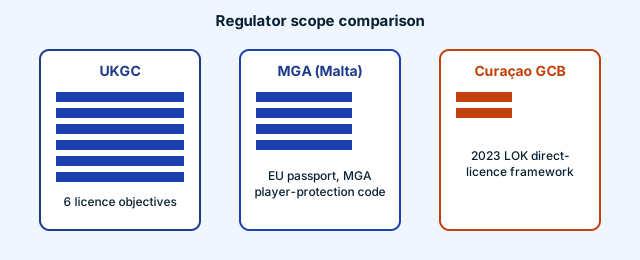
UKGC framework in brief
The UK Gambling Commission was created by the Gambling Act 2005. It is an independent non-departmental public body funded through licence fees paid by the operators it regulates, which insulates it from general Treasury-funding cycles but ties its budget to the size of the licensed market. Its statutory purpose is defined against the three licensing objectives — preventing crime, ensuring fairness, and protecting children and vulnerable persons.
The operating rules the UKGC sets sit in the LCCP, the Licence Conditions and Codes of Practice. The LCCP is one of the longest gambling rule-books in any jurisdiction. It runs to roughly 200 pages and covers everything from advertising standards to complaints handling, from AML procedures to affordability, from age verification to the technical standards that game suppliers must satisfy. Every UKGC-licensed operator must comply with all of it as a condition of holding a licence.
The UKGC also has a rare regulatory power for a gambling authority: the ability to impose financial penalties without going to court, up to any level it considers proportionate, on the basis of a licence-review decision. Individual settlements exceeding £15 million have been agreed in recent years for AML and social-responsibility failings.
The Commission is under ongoing reform pressure. The 2023 White Paper is being consulted and implemented in stages. The introduction of a statutory levy in April 2025 and the pending gambling ombudsman are both directly downstream of the White Paper. This is a live and expanding framework, not a stable one.
Offshore frameworks in brief
The three offshore frameworks that a UK consumer will encounter when reading about non gamstop casinos are, in descending order of consumer-protection depth, the MGA, the Curaçao GCB, and the Anjouan Offshore Gaming Authority. Each rests on its own statute and each is enforced by its own regulator, but they differ significantly in weight.
The MGA operates under the Gaming Act 2018 and a series of subsidiary regulations, chiefly the Gaming Authorisations Regulations and the Player Protection Directive. Its consumer-protection tool-set is codified, its complaint channel through the Player Support Unit is documented, and its licence conditions are broadly consistent with EU norms.
The Curaçao GCB operates under the Landsverordening op de Kansspelen (LOK), extensively amended in 2023. The old master-sub-licence chain has been replaced by direct licensing. Each licensee now applies to the GCB directly and has a named compliance officer. The reforms include tightened AML expectations and a public licence register.
The Anjouan Offshore Gaming Authority operates under the Computer Gaming Licensing Act 2005 (Anjouan). It is the lightest of the three by codified obligations and by enforcement footprint. It has grown as Curaçao consolidated, absorbing operators pushed out by the LOK direct-licence transition who did not want to invest in the higher compliance standard.
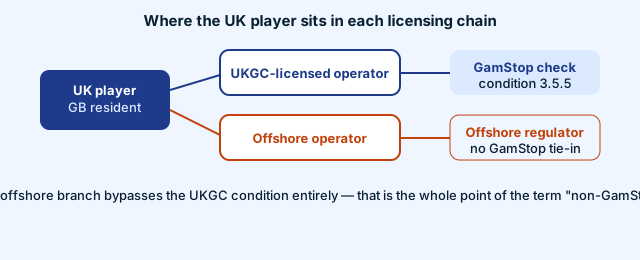
Licence-condition counts side by side
Counting licence conditions is a rough proxy but a useful one. The UKGC LCCP contains, in its current 2026 iteration, approximately 145 individual social-responsibility conditions and ordinary code provisions, plus a further 50 technical-standard conditions. The MGA player-protection framework carries roughly 60 codified conditions, the Curaçao LOK regime carries around 40 after the 2023 reforms (up from about 15 under the old master-sub model), and the Anjouan framework carries roughly 20.
The condition counts break down by theme as follows for UK-relevant consumer protection. On self-exclusion, the UKGC has 6 conditions codified around GamStop and the mandatory ancillary tools; the MGA has 3; Curaçao and Anjouan have 1 each and neither requires participation in a national scheme. On affordability, the UKGC has 8 conditions codified as of 2026; the MGA has 2; Curaçao and Anjouan have none. On advertising, the UKGC has 24; the MGA has 12; Curaçao has 4; Anjouan has 2. On AML the four are much closer, because the international AML framework floors everyone at a similar baseline.
The following table sets the numbers out directly.
| Theme | UKGC (LCCP) | MGA (Malta) | Curaçao GCB (post-LOK) | Anjouan Offshore Gaming |
|---|---|---|---|---|
| Total social-responsibility conditions | ~145 | ~60 | ~40 | ~20 |
| Self-exclusion conditions | 6 (incl. GamStop cond. 3.5.5) | 3 | 1 | 1 |
| Affordability / financial-vulnerability | 8 | 2 | 0 | 0 |
| Advertising, inducements & VIP | 24 | 12 | 4 | 2 |
| Complaints & ADR | 7 + designated ADR list | 4 + PSU | 2 + issuer route | 1 + issuer route |
| Age verification | Codified & audited | Codified | Codified 2023+ | Minimal |
| Player-fund segregation | Codified — 3 tiers | Codified | Recommended only | Not codified |
The counts are approximate — regulators tweak wording between publication cycles — but the ordering is stable and the ratios are meaningful. The UK carries roughly twice the codified consumer-protection weight of the MGA and three to seven times that of the offshore Caribbean regimes.
Enforcement scope and sanction data
Codified conditions matter only if a regulator enforces them. Enforcement can be measured on three axes: sanction volume, sanction size, and licence-revocation rate. On sanction volume, the UKGC has published between 15 and 30 enforcement actions per year since 2019, ranging from advice-and-assistance findings up to full financial penalties. The MGA runs a smaller sanction volume — around 10 per year — from a smaller licensee base. The Curaçao GCB enforcement function has been rebuilt post-LOK and now publishes settled compliance findings, though the volume is lower. Anjouan enforcement is minimal to opaque.
On sanction size, the UKGC's per-case average is materially larger than any offshore counterpart. Individual settlements over £10 million are not rare. MGA penalties are typically in six figures. Curaçao and Anjouan sanctions rarely exceed six figures in local currency.
On licence revocation, the UKGC has revoked or suspended licences at a rate of two to five per year over the past five years. The MGA has revoked licences at a similar rate as a proportion of its book. The Curaçao GCB revoked a substantial number of sub-licensees during the LOK transition; that was a one-off structural event rather than a steady rate.
The following list summarises the practical impact of enforcement asymmetry:
- UKGC financial penalties have a real deterrent effect on operator behaviour, because the numbers are significant relative to operator turnover.
- MGA penalties are meaningful but rarely large enough to force a strategic pivot.
- Curaçao and Anjouan sanctions are more procedural than commercial in impact.
- Licence revocation at the UKGC is a real strategic threat; at Anjouan it is essentially theoretical.
Dispute channels and ADR routing
Complaints channels are where the practical difference is felt by consumers. A UKGC-licensed operator must offer a complaints process. If the consumer is dissatisfied, the operator must direct them to a UKGC-designated ADR provider — organisations such as the Independent Betting Adjudication Service (IBAS), eCOGRA or ProMediate. The ADR provider's decision is binding on the operator up to a threshold. If any step in this chain is not honoured, the UKGC itself can take enforcement action against the operator.
An MGA-licensed operator similarly runs an internal complaints process. Where the consumer disagrees, the Player Support Unit — the MGA's in-house team — can review and, in defined case types, issue a binding decision. The MGA does not maintain a designated-ADR-provider register at the UKGC scale, but the PSU is a codified route.
A Curaçao-licensed operator runs its own process. Escalation goes to the GCB directly. Under the LOK reforms the GCB has begun to publish complaint-handling data, but resolution time is typically longer than the UK route and outcomes are less consistent.
An Anjouan-licensed operator runs its own process. Escalation goes to the licence issuer directly. Time-boundedness of the process is not codified in the licence conditions.
Here is the practical routing tree, in order.
- Raise the complaint with the operator's own customer support. Keep every response, including timestamps.
- If unresolved after the operator's stated resolution window — typically 8 weeks at UKGC-licensed sites and 14 to 21 days at offshore ones — escalate.
- UKGC-licensed operator: escalate to the operator's designated ADR provider. Their decision is binding under the LCCP.
- MGA-licensed operator: escalate to the Player Support Unit inside the MGA.
- Curaçao or Anjouan-licensed operator: escalate to the issuing regulator. Do not expect UK-standard timelines.
Codified consumer-protection tools
The codified consumer-protection tools that must be offered by a licensee tell you what protection you can expect by default. UKGC licensees must offer, at minimum: deposit limits, loss limits, session limits, reality checks at regular intervals during play, single-operator self-exclusion, GamStop registration linkage, and mandatory age verification at deposit. The affordability regime layers on top of these tools rather than replacing them.
MGA licensees must offer deposit limits and self-exclusion tools and must display session-time information. Session-limit tools are recommended rather than mandatory. Age-verification standards are codified at a level below the UKGC 72-hour requirement.
Curaçao-licensed operators must, post-LOK, offer deposit limits and provide the consumer with responsible-gambling messaging. Self-exclusion is required at the operator level. There is no national self-exclusion scheme with cross-operator effect and no equivalent to the UK affordability regime.
Anjouan-licensed operators are subject to the lightest requirements. Deposit limits are recommended, self-exclusion is required at the operator level only, and there is no codified affordability floor.
Anyone reading about non gamstop casinos should understand that the tools you see in an operator's cashier are shaped, at the floor, by the regulator's rule-book. Individual operators may offer more than the rule-book requires. Very few offer materially less, because it becomes hard to defend at renewal. But the floor is what you can rely on when the operator's own commercial incentives push in the other direction.
Register transparency and beneficial-ownership disclosure
Transparency is the least glamorous axis of the comparison and the most useful when you are trying to check an operator's status. The UKGC operates a public licence register that is fully searchable, includes the ultimate beneficial owner disclosure of every licensee, and publishes enforcement actions in a live archive. Historical actions dating back a decade are accessible.
The MGA operates a public register with licensee names, licence types and issue dates. Beneficial ownership is disclosed to the regulator but is not always fully published on the public register. Enforcement actions are announced in a news feed and archived.
The Curaçao GCB post-LOK operates a public register of direct licensees. This is a substantive improvement on the old master-sub system, where sub-licensees were not individually visible. Beneficial-ownership disclosure to the regulator is required, but public transparency remains partial.
The Anjouan register is the least transparent of the four. Licence issuance dates and licensee names are published; beneficial ownership is filed but not consistently public; enforcement actions are rare and inconsistently published.
For a UK consumer trying to verify a claim in an operator's footer, the transparency ordering matters directly. A UKGC number is easy to verify. An MGA number is easy to verify. A Curaçao number can now be verified on the GCB register. An Anjouan number is harder to verify externally.
Practical differences at the account level
The differences codified above express themselves at the account level in six practical ways. First, the sign-up form: at a UKGC-licensed site the age check runs during sign-up and blocks account creation on failure; at an offshore site the age check often runs at withdrawal. Second, the deposit process: UKGC sites cannot accept credit cards, and payment initiation is friction-heavier; offshore sites accept a wider range of methods, including credit. Third, in-session tools: reality checks appear at fixed intervals at UKGC sites; at offshore sites reality checks are either offered as opt-in or absent.
Fourth, the affordability journey: UKGC sites will prompt for extra checks after cumulative loss thresholds; offshore sites do not. Fifth, self-exclusion: at a UKGC site you can register with GamStop and have the exclusion propagate across every UKGC operator; at an offshore site self-exclusion is operator-only. Sixth, dispute resolution: UKGC sites route to a designated ADR provider; offshore sites route back to the licence issuer.
The pattern is consistent across the six practical differences: UKGC-licensed sites carry more friction at the front end and more protection at the back end; offshore sites carry less friction at the front end and less protection at the back end. Which trade-off is right for a given adult consumer is not this article's decision to make — but the consumer should read the trade-off clearly, and the comparison here is intended to help them do that.
Frequently Asked Questions
Does an MGA licence give a UK player UKGC-equivalent protection?
No. The MGA framework is closer to the UKGC than Curaçao is, but the LCCP contains substantially more consumer-protection conditions, the affordability regime does not exist at MGA level, and the UKGC enforcement footprint is larger. It is a middle path, not an equivalent.
Can I use the UK Gambling Commission to escalate an offshore complaint?
No. The Commission has no jurisdiction over an operator it did not license. Its enforcement power under section 33 of the Gambling Act 2005 is directed at operators without a UKGC licence for marketing to Great Britain, not at their individual consumer disputes.
How does the Curaçao 2023 LOK reform change the comparison?
It tightens Curaçao's baseline meaningfully — direct licensing, an accessible register, tighter AML — but leaves Curaçao well below the UKGC on affordability, stake limits, self-exclusion depth and advertising restraint. It is a real improvement without closing the gap.
Are all offshore licences equivalent to each other?
No. MGA, Curaçao and Anjouan differ substantially in codified obligations and enforcement rigour. Anjouan is the lightest of the three; MGA is the heaviest. Treating "offshore" as a single category will mislead you at the operator level.
Do offshore operators still run KYC on UK players?
Most reputable offshore operators do run KYC, typically triggered at withdrawal rather than sign-up. Delayed KYC is a common source of first-payout friction, and enhanced due diligence on larger balances is common at MGA-licensed and post-LOK Curaçao operators.
What is the LCCP?
The Licence Conditions and Codes of Practice — the day-to-day rulebook that sits beneath the Gambling Act 2005 and specifies what UKGC-licensed operators must do. It is where most concrete consumer-protection rules live, including condition 3.5.5 that requires GamStop participation.
Responsible Gambling
Regulation only works if you use it. Deposit and session limits at any licensed operator, UKGC or otherwise, are effective when set before a session begins. GamStop registration is free, covers every UKGC operator, and is deliberately hard to undo. If you have registered and feel the pull to look elsewhere, treat that pull as a signal that the exclusion is working and you should reach out for support. GamCare's helpline runs 24 hours on 0808 8020 133. GordonMoody offers residential treatment. The NHS National Gambling Clinic accepts referrals. BeGambleAware publishes general information. Ask your bank to switch on the gambling-transaction block on your card — every major UK bank supports this and it is often the most effective single intervention.
This site is intended as a consumer information resource for adults. It is not a promotion or endorsement of the operators or licence categories it describes.

Isabella Farrell
Regulation Analyst
Isabella tracks UK gambling law and its offshore counterparts, including the 2023 White Paper reforms, GamStop condition 3.5.5, and comparative regulator effectiveness.
LCCPMGACuraçao GCB