
The legal question in one paragraph
Two questions come up on almost every reader query: is it illegal for me to play at a non-GamStop site, and what does UK law actually say about the market. The short answer to the first is no — the act of playing is not criminalised for an individual UK resident, because the Gambling Act 2005 places the offence at the operator side. The short answer to the second is that UK law is a statute-plus-rulebook system: the Gambling Act 2005 as amended in 2014 is the frame, and the UKGC's LCCP is the operational content. The 2023 White Paper is not itself a statute but a policy document from which secondary legislation is being drafted in stages. This page walks the elements of the framework in the order that matters for a UK adult reading about non gamstop casinos.
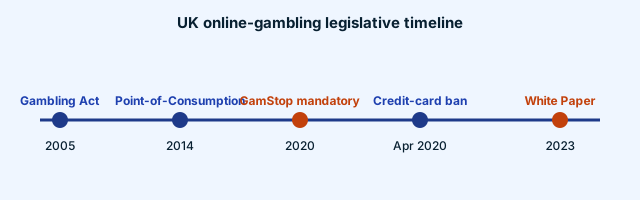
Gambling Act 2005 — the primary statute
The Gambling Act 2005 is the frame around all UK gambling regulation. It received Royal Assent on 7 April 2005 and its main provisions took effect on 1 September 2007. It repealed the Betting, Gaming and Lotteries Act 1963, the Gaming Act 1968 and other earlier statutes, folding them into one Act that specifically anticipated online play. It created the Gambling Commission — later the UK Gambling Commission — as a single regulator with statutory personality.
Section 1 of the Act sets out the three licensing objectives: preventing crime and disorder in connection with gambling; ensuring gambling is conducted in a fair and open way; and protecting children and other vulnerable persons from harm or exploitation. These objectives are the interpretive frame for every regulation and every LCCP condition that has followed.
Sections 33 to 44 create the licensing regime. Section 33 is the criminal offence: providing facilities for gambling to consumers in Great Britain without an operating licence. The scope of what counts as "facilities" is drawn widely; it includes marketing, hosting and account provision. Section 42 creates the offence of cheating.
Part 5 covers premises licences, which are relevant for land-based rather than online play, but the online-play regime is fully covered under the Part 5 remote-gambling provisions and the licence framework built on top of them. The Act empowers the Commission to issue subordinate rules — the LCCP — with enforceable effect.
Gambling (Licensing and Advertising) Act 2014
The 2014 Act is short but consequential. It amends the 2005 Act to shift the trigger for UK licensing from the location of the operator's servers to the location of the operator's consumers. Under the pre-2014 regime, an operator hosted in Gibraltar, Malta or the Isle of Man could serve UK consumers without a UKGC licence, because the offence was tied to the location of gambling activity rather than the location of gambling consumption. Under the 2014 regime, an operator that markets to or provides facilities for consumers in Great Britain must hold a UKGC licence, wherever the servers are physically located.
The Act was a direct response to the erosion of the UK regulatory perimeter that followed the growth of online gambling in the late 2000s. It was politically contested at the time, largely on freedom-to-provide-services grounds under then-EU law. It survived challenge and has been the UK's licensing frame for online gambling ever since.
The consequence for offshore operators today is that any advertising to UK consumers by an operator without a UKGC licence is unlawful in the UK. Operators licensed elsewhere may therefore be careful not to advertise directly to UK IPs, or may use affiliate structures that do so on their behalf. The consumer-side effect is that a great deal of the offshore-operator marketing you might see is presented outside the operator's own domain.
For the primary text see the 2014 Gambling (Licensing and Advertising) Act on legislation.gov.uk.
Section 33 offence — who commits it
Section 33 of the 2005 Act, as amended by the 2014 Act, is the criminal offence that anchors the whole framework. It states that a person commits an offence if they provide facilities for gambling. The offence applies unless the person is acting under a UKGC operating licence, or the gambling is exempt by another route.
The offence has three characteristics that matter for a consumer. First, it is targeted at the supply side. The person committing the offence is the operator, an intermediary, a marketer or an affiliate providing facilities — not the consumer engaging with them. Second, the extraterritorial reach is broad: the offence can be committed by a person outside the UK if they are providing facilities to consumers inside it. Third, penalties are significant: on indictment, an unlimited fine and imprisonment up to 51 weeks (or 6 months in summary proceedings).
The practical enforcement of section 33 is difficult when the operator has no UK presence and no UK-controllable assets. The UKGC uses a combination of tactics: payment-provider blocking, IP blocking through cooperation with ISPs, advertising takedowns via the Advertising Standards Authority, and formal warnings to search engines. These reduce operator reach without producing a criminal outcome.
For a UK reader the important legal point is simple. You are not the person committing the section 33 offence when you play at an offshore site. Your regulatory exposure is instead a set of consumer-side risks — dispute non-recourse, payment friction, affordability erosion — that the offshore-operator framework does not close.
The LCCP as the working rule-book
The LCCP is the layer where most of the operationally consequential regulation sits. It has three parts. The Licence Conditions are attached directly to every operating licence and are legally enforceable in exactly the same way as any provision of the Act. The ordinary Code Provisions are enforceable through the licence-review process. The social-responsibility Code Provisions are enforceable at the same level as licence conditions.
The LCCP is versioned. It is updated after every UKGC consultation cycle. The current 2026 iteration codifies affordability checks (revised April 2025), stake limits (April 2025 for adults, May 2025 for 18–24s), age-verification standards (72 hours at deposit), single-operator self-exclusion rules and, at condition 3.5.5, mandatory participation in the GamStop multi-operator self-exclusion scheme.
Operator responsibilities on customer service, complaints and dispute resolution sit in the LCCP too. So does the codified ADR routing: an operator must offer an ADR channel and must send the consumer to a designated ADR provider on request. The Advertising Code Provisions sit in the LCCP as well, imported from the Committee of Advertising Practice code with UKGC-specific overlays.
A consumer will not typically read the LCCP directly. A consumer will feel its consequences: the number of clicks a UKGC-licensed operator asks before allowing a deposit, the interruptions during play, the friction of an increased deposit request, the immediate response to an ADR-triggering request. All of these come out of the LCCP.
| Instrument | Where it lives | Enforceable how |
|---|---|---|
| Primary Act (Gambling Act 2005) | Statute, sections 1–360 | Criminal offence under section 33; injunctions |
| Point-of-Consumption amendment 2014 | Statute amending 2005 Act | Extends section 33 to consumer-location trigger |
| Licence Conditions (LCCP) | UKGC rule-book, attached to every licence | Licence-review sanction, penalty, revocation |
| Social-responsibility Code Provisions | LCCP subset | Enforceable as licence conditions |
| Ordinary Code Provisions | LCCP subset | Considered in licence review |
| 2023 White Paper | DCMS policy document | Not directly enforceable; drives secondary legislation and LCCP updates |
The credit-card ban of April 2020
Credit-card gambling has been prohibited in Great Britain since 14 April 2020. The rule is set by the UKGC through an amendment to the LCCP that took effect on that date, and it covers online and remote-betting products regulated by the Commission. The prohibition captures direct credit-card deposits at the operator, as well as indirect routes such as topping up an e-wallet with a credit card immediately before a gambling deposit.
The rule contains a small carve-out for non-remote gambling — physical premises — where cash and non-credit payment methods dominate anyway. The National Lottery is inside the same rule under a parallel provision. Debit-card products issued against a credit facility are treated as credit cards, on the operator's payment-scheme-code identification.
The evidence base for the ban was strong. Consumer research had shown that gambling with borrowed money was disproportionately associated with problem-gambling outcomes. The Commission's consultation on the ban received unusually broad support from industry, third-sector organisations and consumers. Implementation involved close coordination with the card schemes to ensure the merchant-category code for gambling was applied consistently.
Offshore operators are not bound by the UK credit-card ban. Some accept credit-card deposits openly; some are declined by UK issuers at the merchant-category-code level, because UK banks apply the rule as a card-scheme rule rather than as a UK-perimeter rule. A UK cardholder who uses a credit card at an offshore operator will often find the transaction classified as a cash advance — interest accrues from the transaction date, and the effective borrowing cost rises materially. Chargeback rights on gambling merchant-category codes are also narrower than on general retail.
Affordability checks and stake limits
Affordability is the most contested reform of the current UK cycle. The regime has two tiers. A light-touch check runs at £125 net loss over a rolling 30-day window, or £500 over 365 days, and is required to be frictionless — the operator queries public data sources such as County Court Judgments and Individual Voluntary Arrangements, without asking the consumer for documents. An enhanced check runs at higher thresholds; it can require the consumer to provide payslips, bank statements or accountant letters, and can pause account activity while it is completed.
Stake limits on online slots took effect for adults in April 2025 at £5 per spin, and for consumers aged 18 to 24 in May 2025 at £2 per spin. The rule applies to the underlying game round, not to any bonus, gamble step or feature bet inside the round. It applies to slot content only; table games and live-casino products remain outside the online-slot stake regime.
The two rules interact. Affordability checks are triggered by net losses. Stake limits are per-spin. A consumer at a UKGC-licensed operator now hits both mechanisms: their maximum per-spin exposure is capped, and their cumulative loss is monitored. Together the two produce a compressed harm profile relative to the pre-2025 UKGC regime and to the offshore market at any point.
The affordability check runs in a defined sequence when it is triggered at a UKGC operator:
- Cumulative net loss for the consumer's account is checked against the £125 rolling 30-day or £500 rolling 365-day thresholds at each deposit.
- If the threshold is crossed, the operator pulls a light-touch financial-vulnerability profile from public data — no consumer action required.
- Where the profile clears, the account continues to trade normally; the check is logged for audit.
- Where the profile flags concern, the operator can prompt an enhanced check, which may require the consumer to submit documents.
- Enhanced checks pause activity above the reviewed limit until documents are received, reviewed and signed off by a nominated officer.
Neither rule attaches to offshore operators. This is not a policy oversight; it is a jurisdictional fact. Rules imposed on a UKGC licence do not travel with the licensee to a non-UKGC-licensed operator, and cannot be applied by the UKGC to an operator it does not licence. For a UK consumer, the affordability and stake-limit protections switch off entirely when they cross into a non gamstop casinos context.
2023 White Paper — reform architecture
The 2023 White Paper is the current organising document for UK gambling reform. Titled High Stakes: Gambling Reform for the Digital Age, it was published by the Department for Culture, Media and Sport in April 2023. It runs to nearly 270 pages and covers reforms grouped into five families: player protection, product-safety limits, market structure, industry contributions and complaints resolution.
The implementation timeline stretches across three years. Affordability was consulted first, with light-touch checks operational from August 2024 and enhanced checks phased in through 2025. Stake limits followed in April and May 2025. The statutory operator levy, at 1.1 per cent of gross gambling yield, went live in April 2025 through a Treasury order. The ombudsman is in flight, with consultation on scope and funding running through 2026.
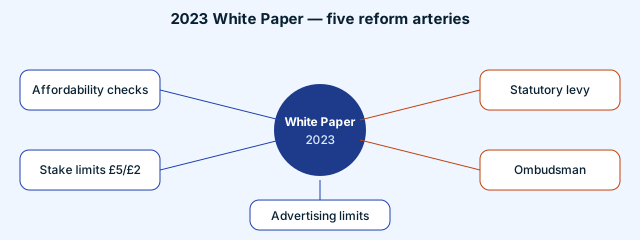
The five reform families of the White Paper, listed once for reference:
- Player-protection: affordability checks in two tiers, cross-operator single customer view exploration.
- Product-safety limits: £5 and £2 online-slot stake caps by age cohort.
- Market-structure: statutory levy at 1.1 per cent of gross gambling yield.
- Complaints: a dedicated gambling ombudsman outside the operator's own process.
- Advertising and inducements: tighter rules on VIP schemes, cross-selling and mandatory affordability tags on bonus offers.
The commercial impact on the UK-licensed operator base has been significant. Gross gambling yield growth has slowed. Marketing spend has re-oriented toward retention rather than acquisition. Some smaller UKGC operators have exited the market or been acquired. The reform cycle is, by any measure, one of the most consequential regulatory pivots any consumer market has seen in the past decade.
For readers of this site the White Paper matters because it explains why the gap between UKGC and offshore has been widening rather than narrowing. The White Paper is a UK-perimeter document. Offshore operators are not covered. The direction of travel is more protection inside the UK, and the same-or-lower protection outside it — a gap that grows every quarter.
Player-side tax treatment of winnings
UK gambling winnings are not subject to UK income tax for individual consumers. The treatment has been consistent since the 2001 duty reform, when the levy on gambling shifted from the consumer to the operator. Neither the Gambling Act 2005 nor the 2014 amendment altered this position. The reform White Papers and subsequent regulations have not altered it either.
The treatment applies regardless of the licensing jurisdiction of the operator. Winnings from a UKGC-licensed operator, an MGA operator, a Curaçao operator or an Anjouan operator are equally outside UK income tax for individuals. There is no distinction in the Income Tax Act, in the CTA 2009, or in HMRC's own guidance between UK-licensed and non-UK-licensed gambling winnings on the receiving-consumer side.
Two practical clarifications matter. First, professional-gambler treatment does exist as a rare category, and it applies to structured, systematic-income activity — but it is narrow and case-specific, and consumers should not assume it applies to their casino activity. Second, the tax treatment of interest on gambling balances or on cryptocurrency holdings that pass through a gambling account can be different from the winnings themselves.
The tax-neutral treatment of winnings is worth noting because it is one of the few areas where the offshore-versus-UKGC gap does not exist. Everything else on this page describes a difference; this line describes an equivalence.
Frequently Asked Questions
What is the primary UK gambling statute?
The Gambling Act 2005, as amended by the Gambling (Licensing and Advertising) Act 2014 and by regulations issued under it since. The Commission's LCCP sits beneath the statute and carries most of the operational rules.
When did the UK credit-card gambling ban take effect?
14 April 2020. It applies to almost all gambling regulated by the UKGC, including through indirect routes such as e-wallets funded from credit cards. It does not extend to offshore-licensed operators.
What are the current UK online-slot stake limits?
£5 per spin for adults from April 2025, and £2 per spin for consumers aged 18 to 24 from May 2025, at UKGC-licensed operators. The rule applies to the underlying game round, not to bonus or gamble steps within it.
What does the 2023 White Paper implement most tangibly?
Affordability checks in two tiers, online-slot stake limits, a statutory operator levy at 1.1 per cent of gross gambling yield, and a gambling ombudsman for dispute resolution outside the operator's own process.
Does UK law criminalise playing at an offshore operator?
No. The Gambling Act 2005 offences under section 33 target operators providing facilities to consumers in Great Britain without a UKGC licence, not the consumers themselves. Consumer-side risks are practical rather than criminal.
What is the statutory levy?
A mandatory 1.1 per cent operator contribution on gross gambling yield introduced in April 2025 to fund research, prevention and treatment of gambling-related harm, replacing the previous voluntary contribution system.
Responsible Gambling
UK gambling law exists because gambling causes measurable harm at the population level, and because consumer protection is not automatic. If your own play is causing you difficulty, treat that as a signal. GamCare's helpline is 0808 8020 133, available 24 hours. GordonMoody offers structured residential and online treatment. The NHS National Gambling Clinic in London and other NHS gambling clinics around the country accept referrals. BeGambleAware publishes general information. Consider registering with GamStop — it is free, covers every UKGC-licensed operator, and is deliberately hard to reverse. Ask your bank to switch on a gambling-transaction block on your card; the major UK high-street banks now support this.
For statutory background, the Gambling Act 2005 is on legislation.gov.uk. The GOV.UK guidance on licensing generally covers the licence-plus-enforcement model. The Wikipedia summary of UK gambling law is a reasonable starting point.

Isabella Farrell
Regulation Analyst
Isabella tracks UK gambling law and its offshore counterparts, including the 2023 White Paper reforms, GamStop condition 3.5.5, and comparative regulator effectiveness.
Gambling Act 2005White Paper 2023LCCP