
Why EU regulation still matters for non gamstop casinos
UK readers looking at non gamstop casinos sometimes assume the operators are all Caribbean-licensed. In practice, a meaningful share are licensed in Malta by the MGA, an EU regulator with a codified player-protection framework. Others are licensed in EU jurisdictions that are less prominent as offshore hubs — Estonia, Isle of Man for near-EU purposes, and Gibraltar under its own regime. Whether or not the operator you are reading about is EU-licensed, the EU regulatory context shapes the reference point for how consumer-protection frameworks are drafted at MGA and what constraints a member state can place on foreign operators.
This matters practically because the offshore market is not a homogeneous block. An MGA-licensed operator that serves UK players operates under an EU-style consumer-protection code with an ADR route. A Curaçao-licensed operator operates under a very different code. The reader who understands the difference reads the operator's licence footer accurately.
There is no single EU gambling regime
Gambling is a member-state competence in the European Union. There is no Gambling Directive equivalent to the AML Directive or the E-Money Directive. Attempts to bring gambling within EU harmonisation have consistently failed since the late 1990s, most notably during the Services Directive negotiations, where gambling was explicitly excluded from the scope of intra-market liberalisation.
The EU-level constraints that do apply are indirect. Freedom-to-provide-services under Article 56 TFEU applies in principle, but the CJEU has consistently held that member states may restrict gambling for public-interest reasons, provided the restrictions are proportionate, consistent and non-discriminatory. AML floors under the 5th and 6th AML Directives apply to gambling operators, and Payment Services Directive rules apply to the payment rails they use. GDPR applies to the data they process. But the substance of gambling regulation — licensing, tools, stake limits, self-exclusion — is national.
The result is a patchwork. Malta is a hub jurisdiction with a light-but-real code. Germany runs a joint federal-state Interstate Treaty regime with strong deposit limits and a mandatory single self-exclusion register (OASIS). Sweden operates a Spelinspektionen-licensed monopoly-adjacent regime. Netherlands runs a Kansspelautoriteit regime with strict advertising restrictions. Italy runs an ADM regime with mature player-protection tools. Spain runs a DGOJ regime. Each has its own logic; none is directly transferable to another.
The MGA (Malta) framework in detail
The Malta Gaming Authority framework rests on the Gaming Act 2018 (Chapter 583, Laws of Malta) and its subordinate regulations. Malta re-issued its gambling framework in 2018 to consolidate what had previously been four separate licence classes into a single multi-licence structure with two main categories — business-to-consumer and business-to-business.
The B2C licence carries the consumer-protection code that concerns UK readers. It requires an operator to maintain player-fund segregation, offer deposit limits, offer self-exclusion tools at the operator level, provide access to a codified complaint route through the Player Support Unit, and publish game rules and RTP data. It also requires the operator to run KYC procedures aligned with the EU AML floor.
The Player Support Unit is the MGA feature most worth understanding. It is an in-house team inside the regulator that accepts consumer complaints once the operator's own process has been exhausted. For defined case categories, the PSU can issue binding decisions on the operator. The scope is narrower than the UKGC-designated ADR panel, but it is a real route.
The MGA does not operate a national self-exclusion register with cross-operator effect for foreign consumers. Self-exclusion works at the operator level under an MGA licence. A UK consumer who self-excludes at one MGA operator will not automatically be self-excluded at another. This is one of the practical differences between an MGA licence and a UKGC one on the consumer-protection axis that matters most for the offshore market.
A less-discussed side of the MGA framework is the technical-standards regime. Malta requires game suppliers to be independently certified by an accredited testing laboratory. RNG independence, RTP disclosure and technical fairness are all codified. On this axis the MGA is broadly comparable to the UKGC, and materially ahead of Curaçao and Anjouan. It is one of the reasons that a UK reader will find the game libraries at MGA operators to look and feel familiar — many of the same suppliers, certified by the same laboratories, sit under both licences.
The MGA also runs an Operator Self-Regulatory Compliance Programme and an annual system audit requirement. These are procedural rather than consumer-facing, but they shape whether an operator that holds a licence today will still hold one in two years. Operators that fail their audit lose the licence. Those that pass carry the MGA mark into their next commercial cycle.
Freedom to provide services and gambling
Freedom to provide services under Article 56 of the Treaty on the Functioning of the European Union is the theoretical starting point for EU-level gambling law. The principle is that a service provider established in one member state may offer services to consumers in another without additional national licensing, subject to public-interest justifications.
The Court of Justice has consistently qualified this principle for gambling. Member states may restrict cross-border gambling supply provided the restriction serves a legitimate public-interest objective — most often consumer protection, prevention of problem gambling, or prevention of financial crime — and provided the restriction is proportionate and consistent. Restrictions that are inconsistent, discriminatory or disproportionate can be struck down.
The practical effect is that a member state cannot arbitrarily exclude foreign operators, but can require them to hold a national licence if the national licensing regime is genuinely aimed at consumer protection and applied evenly. Almost every EU member state now operates such a national licensing regime for online gambling.
Individuals reading about non gamstop casinos should note that the freedom-to-provide-services jurisprudence is about operator rights, not consumer rights. It does not create a consumer entitlement to cross-border play. It shapes the operator-side legal environment inside the EU, which in turn shapes what the MGA and other national regulators can and cannot codify.
Court of Justice cases that set the floors
A small number of CJEU cases have shaped the current EU gambling landscape. The following are the ones that come up most often in academic and practitioner commentary.
- Placanica (Case C-338/04), 2007. Confirmed that Article 56 TFEU applies to gambling, but that member states may restrict cross-border gambling supply on public-interest grounds.
- Liga Portuguesa (Case C-42/07), 2009. Upheld Portugal's ability to grant an exclusive licence to a state-linked operator, reasoning that gambling restrictions may be justified by consumer protection and fraud prevention.
- Sporting Exchange (Case C-203/08), 2010. Addressed Netherlands' licensing monopoly, again applying the proportionality-and-consistency test.
- Carmen Media (Case C-46/08), 2010. Held that German restrictions on online gambling were not consistent enough to justify excluding EU-licensed operators.
- Zeturf (Case C-212/08), 2011. Applied the same framework to horse-race betting in France.
The pattern across the case law is stable. Member states can restrict; they must justify the restriction; they must apply it consistently; and they cannot use it as a cover for economic protectionism. Sensible national regimes have generally survived challenge. Regimes that were opaque or arbitrary have not.
Two further points on the case law are worth flagging. First, the CJEU has consistently held that member states which liberalise domestic gambling markets while restricting foreign supply may fail the consistency test, because the domestic-supply incentive undermines the consumer-protection justification. Second, the CJEU has increasingly accepted a wide margin of appreciation for member states on gambling, reflecting the social sensitivity of the policy area. Both trends have made national gambling regimes more defensible in principle, and simultaneously more heterogeneous in practice.
Germany, Sweden, Netherlands and Italy compared
A short tour of the four largest EU regimes highlights how varied national gambling regulation is inside the EU.
| Member state | Regulator | Self-exclusion register | Notable feature |
|---|---|---|---|
| Germany | Gemeinsame Glücksspielbehörde (GGL) | OASIS national register | €1 default stake cap on slots; €1,000/month cross-operator deposit cap |
| Sweden | Spelinspektionen | Spelpaus.se national register | Mandatory pre-session deposit limits |
| Netherlands | Kansspelautoriteit (KSA) | Cruks national register | Strict marketing ban targeting under-24s |
| Italy | Agenzia delle Dogane e dei Monopoli (ADM) | RUA (Registro Unico Autoesclusi) | Long-running mature framework since 2011 |
What is striking is that each of the four operates a national self-exclusion register broadly comparable to GamStop. This is a common feature of mature EU regimes, and it is one of the ways in which the offshore Curaçao and Anjouan regimes are anomalous compared to the mainstream EU picture.
Post-Brexit UK–EU divergence in gambling law
Brexit did not immediately change UK gambling law, because UK law had already diverged from an EU-average template for a decade. What Brexit changed was the interpretive baseline. Pre-Brexit, UK legislation was drafted with an awareness of EU freedom-to-provide-services constraints. Post-Brexit, that constraint is gone.
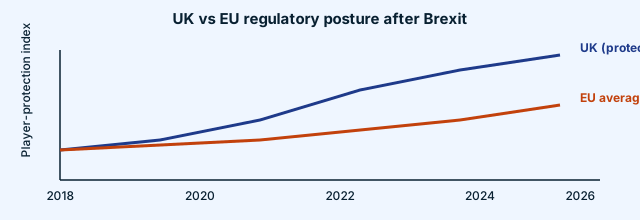
The 2023 White Paper reforms — affordability, stake limits, the statutory levy and the ombudsman — are exactly the sort of package that would previously have been drafted with an eye to CJEU proportionality-and-consistency review. They are now drafted without that overhang. That is why UK protection standards are moving up faster than the EU average: the constraint on how quickly UK reform can rise has been lifted.
On the offshore side, the MGA remains a full EU regulator with EU proportionality constraints still in play. Curaçao and Anjouan are outside the EU entirely and are not directly affected. The consumer-side effect is a divergence: UK protection is rising, MGA protection is roughly flat, offshore-non-EU protection is inching up but from a lower base.
UK players did lose one thing they never really had in practice. Pre-Brexit, in principle, an EU-licensed operator could argue that UK restrictions were disproportionate under Article 56. Post-Brexit, that route is closed. UK regulatory sovereignty is stronger; the check on it is weaker; and reform is faster.
The passport myth and why an MGA licence is not automatic
A recurring misconception in operator marketing is that an MGA licence confers "EU-wide" rights. It does not. There is no gambling passport equivalent to the banking, e-money or investment-services passports. An MGA licence entitles the operator to serve Maltese consumers under Maltese law and to be recognised as an EU-licensed entity for purposes such as EU AML compliance — but not to serve consumers in Germany without a German licence, in Sweden without a Swedish licence, or in the Netherlands without a Dutch licence.
The practical implication is that an operator with only an MGA licence, marketing to a UK consumer, is doing so outside both the UKGC framework (which it does not hold) and the freedom-to-provide-services intra-EU framework (which no longer applies to UK consumers post-Brexit). The MGA licence is a real consumer-protection instrument at the operator side, but it does not create a UK regulatory presence.
Some operators dual-licence: they hold both an MGA licence and a UKGC licence, and route UK consumers through the UKGC entity. Those are UKGC-licensed operators from a UK consumer perspective, and they are not what we mean when we talk about non gamstop casinos. The MGA-only operators that market to UK consumers are a smaller and different category, and they are the ones that matter for this page.
Where the EU picture is going
The direction of EU gambling regulation is broadly consistent across member states. Codified affordability floors are becoming more common; German-style deposit caps are being watched by other regulators; national self-exclusion registers are gradually spreading; advertising restrictions are tightening. The mean EU regime is moving toward the UK direction of travel, just slower.
Two Commission consultations in 2024 and 2025 touched on cross-border consumer-protection cooperation. Neither produced binding harmonisation. Both signalled that some form of EU-level self-exclusion cooperation may eventually become politically viable, though not on any near-term timeline.
Malta is under pressure from other member states over the reach of its licensing framework to non-Maltese consumers. The MGA's position remains that Maltese licence-holders may serve consumers cross-border under EU freedom-to-provide-services principles, subject to national restrictions where they exist. Other member states dispute this application. Enforcement conflicts have arisen most sharply with Germany and Austria.
For a UK reader, the practical takeaway is that the EU picture is fluid and heterogeneous, that the MGA is the most consumer-protective offshore licence a UK consumer will regularly encounter, and that neither MGA nor any EU regime is a substitute for the UKGC framework for consumers who are actually resident in Britain. For further primary text see the EU legal database EUR-Lex.
Frequently Asked Questions
Does the EU regulate online gambling centrally?
No. Gambling is a member-state competence. The Court of Justice of the EU sets floors and constraints under freedom-to-provide-services jurisprudence, but there is no Gambling Directive and no central licensing regime.
How does the MGA compare to national EU regulators?
The MGA is a hub regulator with a mature player-protection code. Germany, Sweden and Netherlands operate more restrictive national regimes with national self-exclusion registers. Italy and Spain sit closer to the MGA in overall approach.
Which ECJ cases matter for gambling?
Placanica, Liga Portuguesa, Sporting Exchange, Carmen Media and Zeturf are the key freedom-to-provide-services cases that shaped EU-level constraints on how far member states can restrict foreign operators.
Did Brexit change the MGA framework?
No, the MGA rules did not change, but the EU-UK relationship on gambling did. UK players lost the freedom-to-provide-services argument as a route to challenge UK restrictions, and UK reform is now free to rise above the EU-average template.
What is passporting in gambling regulation?
There is no formal gambling passport in the EU. An MGA licence does not entitle the holder to operate in Germany, Sweden or another member state without that state's separate licence.
Are non-EU offshore regulators bound by EU rules?
No. Curaçao and Anjouan operate under their own domestic frameworks and are not subject to EU rulemaking or CJEU case law. They are affected indirectly by international AML standards and by the EU AML Directives insofar as their operators seek EU banking access.
Responsible Gambling
Understanding EU regulation does not change your consumer position. If you are worried about your own play, the UK support network is what matters. GamCare's helpline is 0808 8020 133, available 24 hours. GordonMoody provides structured treatment programmes. The NHS National Gambling Clinic accepts referrals. BeGambleAware publishes general information. If you have not already, consider registering with GamStop — it is free, covers every UKGC-licensed operator, and is deliberately hard to reverse. Ask your bank to activate the gambling-transaction block on your card.
For further reading, EU legal texts are on EUR-Lex. UK statutory instruments are on legislation.gov.uk. The EU law summary on Wikipedia and the OECD consumer-finance materials both offer wider context.

Isabella Farrell
Regulation Analyst
Isabella tracks UK gambling law and its offshore counterparts, including the 2023 White Paper reforms, GamStop condition 3.5.5, and comparative regulator effectiveness.
MGAEU case lawPost-Brexit